It rained the day we left our beautiful valley and
friends at the chalet. The night before, Whitney had climbed up onto the deck
of a barn to escape the rain under the eaves. Down in the valley, I had scrunched in with my
paraglider under my minimalist rainfly while the torrent let loose. In the
morning, Jessie made us coffee, and when we left she gave us a big hug.
"You seemed quite happy here," she said, "but next time just
stay with me in Mürren." Simon and Andre came out of the kitchen to bid us
farewell, and they thanked us for hanging out with them.
 We took a high trail along the mountain and down to the town of Lauterbrunnen,
since there was no other way to get down into the valley again besides with a
cable car or paraglider, the latter being impossible due to the thick fog that
morning. I picked blueberries and raspberries along the way, which had all been
freshly washed by the rain. Friendly cows loitering along the path sniffed and
nuzzled us as we passed.
We took a high trail along the mountain and down to the town of Lauterbrunnen,
since there was no other way to get down into the valley again besides with a
cable car or paraglider, the latter being impossible due to the thick fog that
morning. I picked blueberries and raspberries along the way, which had all been
freshly washed by the rain. Friendly cows loitering along the path sniffed and
nuzzled us as we passed.
 We took a high trail along the mountain and down to the town of Lauterbrunnen,
since there was no other way to get down into the valley again besides with a
cable car or paraglider, the latter being impossible due to the thick fog that
morning. I picked blueberries and raspberries along the way, which had all been
freshly washed by the rain. Friendly cows loitering along the path sniffed and
nuzzled us as we passed.
We took a high trail along the mountain and down to the town of Lauterbrunnen,
since there was no other way to get down into the valley again besides with a
cable car or paraglider, the latter being impossible due to the thick fog that
morning. I picked blueberries and raspberries along the way, which had all been
freshly washed by the rain. Friendly cows loitering along the path sniffed and
nuzzled us as we passed. 
We waited and waited with our thumbs out, thinking our
pitiful state would soften hearts, but cars whooshed on by through the rain for
an hour or so. Gstaad, our next destination, was more than an hour and a half
driving time away, and we had a couchsurfing host expecting us that afternoon.
I’ve noticed that waiting for a ride hitchhiking isn’t so bad if you can walk,
because you feel at least like you’re making some progress, like moving from
one fishing hole to another. But with all the rain we were stuck in a town of
elderly people driving expensive cars who had no time for our riffraff.
I took a lunch break, but Whitney decided to wait just down the road still trying. Finally, a young guy in a little car pulled over for her, and assented when she asked if I could come too. His windows fogged up almost immediately from our wet clothes. Even though he could only give us a short ride back up to Interlaken, it was a much-needed boost of spirits.
I took a lunch break, but Whitney decided to wait just down the road still trying. Finally, a young guy in a little car pulled over for her, and assented when she asked if I could come too. His windows fogged up almost immediately from our wet clothes. Even though he could only give us a short ride back up to Interlaken, it was a much-needed boost of spirits.
 Another man picked us up almost immediately from the gas
station where we'd been dropped off and told us he would take us to a better
place in Interlaken to catch rides--a grungy flea market on the road to Spiez
where we waited a long time again. Eventually a nice man in a van with baby car
seats took us to Spiez. Whitney apologized in German that we smelled like wet
animals, and he laughed. I suppose we usually smelled like dry animals. The
road from Spiez to Gstaad was long, small, and full of tiny towns where cars
would probably be stopping. With the rain continuing and most of the day gone,
we decided to bite the bullet and fork out the 26 francs for a train ticket the
rest of the way. Sitting in the warm train bound punctually and immutably for
our destination felt like hiring a limousine.
Another man picked us up almost immediately from the gas
station where we'd been dropped off and told us he would take us to a better
place in Interlaken to catch rides--a grungy flea market on the road to Spiez
where we waited a long time again. Eventually a nice man in a van with baby car
seats took us to Spiez. Whitney apologized in German that we smelled like wet
animals, and he laughed. I suppose we usually smelled like dry animals. The
road from Spiez to Gstaad was long, small, and full of tiny towns where cars
would probably be stopping. With the rain continuing and most of the day gone,
we decided to bite the bullet and fork out the 26 francs for a train ticket the
rest of the way. Sitting in the warm train bound punctually and immutably for
our destination felt like hiring a limousine.
Twilight fell over Gstaad, a town pleasantly nestled in rolling hills, unlike Mürren which leaned precariously against the edge of a spectacular cliff. After seeing the small airport crammed with private jets and the many ski lifts around, I began to think of it as a Swiss version of Jackson Hole. Marco, our host, waved at us from across the train station. He was somewhere in his 40s, with curly hair and glasses and a kind face. By his own admission, he was an introvert and had grown up very shy, but he loved hosting the travelers who poured through his house up to several times a week. When he was a little boy, he wouldn’t even accept candy from his grandparents, because he was too shy to have to say thank you. But he was a wonderful host, and full of surprises.
He set the next day aside to take us on one of his
favorite local hikes. When we woke up to rain, I told him I expected better of
Switzerland and was inclined to file a complaint. He quickly retorted that the
weather came from France. However, it soon let up, and we headed for the hills.
 mountain where they keep cows and pigs
and make cheese. We had the good fortune to arrive on the day they were moving
the cows down from the high pastures. An older but very strong-looking woman
named Christine gave us a quick tour of their cheese-making facilities while
her son and daughter-in-law brought in the cows and hung ornately decorated
bells the size of small trash cans on the cows’ necks. Christine’s husband and
son put on collared shirts and tucked them into their trousers as if they were
getting ready to attend the opera. They call this bringing down of the cows the
“desalpe,” an age-old tradition that is a really big deal.
mountain where they keep cows and pigs
and make cheese. We had the good fortune to arrive on the day they were moving
the cows down from the high pastures. An older but very strong-looking woman
named Christine gave us a quick tour of their cheese-making facilities while
her son and daughter-in-law brought in the cows and hung ornately decorated
bells the size of small trash cans on the cows’ necks. Christine’s husband and
son put on collared shirts and tucked them into their trousers as if they were
getting ready to attend the opera. They call this bringing down of the cows the
“desalpe,” an age-old tradition that is a really big deal.
Christine, who was a second-generation farmer, said
 that
for a while they weren’t sure whether any of their children would get involved
and keep the family farm going. But her son and his wife finally decided they
would take the torch. Her son, all dressed up for the desalpe, stood on the
other side of the trailer which held the calves who were too young to make the
journey down. Under the trailer I could see the feet of his wife approach his
and lean up on their toes where the two came together. It must be a satisfying
life, I thought.
that
for a while they weren’t sure whether any of their children would get involved
and keep the family farm going. But her son and his wife finally decided they
would take the torch. Her son, all dressed up for the desalpe, stood on the
other side of the trailer which held the calves who were too young to make the
journey down. Under the trailer I could see the feet of his wife approach his
and lean up on their toes where the two came together. It must be a satisfying
life, I thought.
 A few moments later an explosion of bells rang out, and
an explosion of cows flooded out of the barn. I did my best to film them while
at the same time dashing in front of strays to steer them back to the group. It
sounded like a wedding and looked like a slow stampede. When the cacophony
faded, we waved goodbye to Christine and continued our hike.
A few moments later an explosion of bells rang out, and
an explosion of cows flooded out of the barn. I did my best to film them while
at the same time dashing in front of strays to steer them back to the group. It
sounded like a wedding and looked like a slow stampede. When the cacophony
faded, we waved goodbye to Christine and continued our hike. Now I’m no wimp when it comes to the outdoors, but what
Marco called a hike, I would call a climb. The mountain he led us to was so
steep its name means “The Carrot”.
Now I’m no wimp when it comes to the outdoors, but what
Marco called a hike, I would call a climb. The mountain he led us to was so
steep its name means “The Carrot”.  “You tell me if you are not feeling comfortable on the
way up,” he said, “Or on the way down.” He said other friends had asked him
about the hike and whether it was dangerous. “No, it’s not dangerous,” he said.
“But if you fall, you die.” Our climbing route was a type of via ferrata, which means “iron route,” which
means that cables and bars have been drilled into the rock to allow passage
along otherwise impassible cliffs. Usually people rent a via ferrata kit, which includes a helmet, a harness, and two carabiners
so that at least one is attached at all times. Sans kit, I kept one sweaty hand
on the cable as much as possible. I let Marco go first to show Whitney the way,
and Whitney second so I could watch whatever rocks they might bump come
whizzing down past my head and get the full Tolkien experience. (To their
credit as experienced mountain climbers, neither ended up dislodging any
rocks.)
“You tell me if you are not feeling comfortable on the
way up,” he said, “Or on the way down.” He said other friends had asked him
about the hike and whether it was dangerous. “No, it’s not dangerous,” he said.
“But if you fall, you die.” Our climbing route was a type of via ferrata, which means “iron route,” which
means that cables and bars have been drilled into the rock to allow passage
along otherwise impassible cliffs. Usually people rent a via ferrata kit, which includes a helmet, a harness, and two carabiners
so that at least one is attached at all times. Sans kit, I kept one sweaty hand
on the cable as much as possible. I let Marco go first to show Whitney the way,
and Whitney second so I could watch whatever rocks they might bump come
whizzing down past my head and get the full Tolkien experience. (To their
credit as experienced mountain climbers, neither ended up dislodging any
rocks.)
 A stately Ibex stared down at us from the tip top of the
carrot, probably laughing at our slow and awkward pace over what he could do
just fine without cables.
A stately Ibex stared down at us from the tip top of the
carrot, probably laughing at our slow and awkward pace over what he could do
just fine without cables. My effort was rewarded near the top with a whole patch of snow-white edelweiss—the first I’d seen in the wild. At the top of the carrot was a metal cross, and attached to the cross was a box with a mountain register with one blank page left. We all signed our names, and I included my favorite lines of poetry, “...To sail beyond the sunset, and the baths of all the western stars, until I die.”

Clouds swirled
around, alternately obscuring and revealing the cliff walls all around us that
fell away to semi-cliffs, and then to villages thousands of feet below. Far
away, we could even see Eiger and Jungrau freshly dusted with snow from the
night before.
On the way back,
we stopped to chat with a very friendly cow. She seemed particularly attracted
to Marco. He stroked her nose tenderly, but said, “Sorry, I prefer girls
without horns.” This, I think was an unfair judgment upon the cow whose horns
had nothing to do with diabolical character, but I have to agree with Marco.
Thank God for girls without horns.

It was good we made it back down alive, because if that view wasn’t to die for, dinner that night was. Marco pulled out a huge block of raclette cheese and fired up the heater that would melt it onto our hot potatoes and pickles and veggies. We each had a beer that his Polish guests from earlier that week had given him as a gift. Oh what a change from the carrots and bread I’d been eating day after day.

 The next couple
days with Marco were delightful. We made pancakes with Ovomaltine “Crunchy
Cream” on them, and tried the Swiss soda Rivella, 35% of which consists of the clear
milk serum left over from cheese-making. I bought a charcoal pencil from a
bookstore in town and tried to sketch some scenes from the trip so far. Another
Swiss tradition, it seems, is for cats to sit out in the middle of fields, rain
or shine, and look for mice. There are so many cats doing this all the time
that Whitney and I started a game of calling out “cat-in-a-field!” each time we
spotted one. Whoever won at the end of the day, we each had a satisfyingly
large tally.
The next couple
days with Marco were delightful. We made pancakes with Ovomaltine “Crunchy
Cream” on them, and tried the Swiss soda Rivella, 35% of which consists of the clear
milk serum left over from cheese-making. I bought a charcoal pencil from a
bookstore in town and tried to sketch some scenes from the trip so far. Another
Swiss tradition, it seems, is for cats to sit out in the middle of fields, rain
or shine, and look for mice. There are so many cats doing this all the time
that Whitney and I started a game of calling out “cat-in-a-field!” each time we
spotted one. Whoever won at the end of the day, we each had a satisfyingly
large tally.
When it came time
to leave, Marco printed out a sign for us in about 300-point font that said “Bulle,”
our next destination. Somehow we inspired him to start a guestbook, which we
got to be the very first to sign. For all its private jets, the people of
Gstaad were downright overwhelming when it came to hitchhiking. Whitney and I
stood at the local roundabout with our 300-point “Bulle” and watched as driver
after driver smiled, waved, or threw up both hands in dramatic apology for not
being able to give us a lift. One man screeched to a halt in the middle of the
roundabout, rolled down is window, and shouted, “I’m sorry, but I’m only going
another hundred meters in this direction, so if I were to pick you up, it
wouldn’t do you very much good!” We absolved him frantically, hoping nobody
would slam into the back of his car before he got on his way again.

Soon a beater Citroën pulled over, and a young guy in a sweatshirt said in broken English through a cigarette that it wasn’t even his car, but to hop in. What, did you steal it? I thought to myself, but hopped in nonetheless. Adrian (“ah-dri-AHN”) was from Romania and was our most friendly ride yet. He was borrowing the car from a friend to go get a passport photo taken in Château-d'Oex, but decided to drive an extra 40 miles out of his way just to drop us off where we were trying to go. He had to put in more gas for the drive, but wouldn’t accept any money for it. Whitney told me later how satisfying it was to hear what his nationality was. Apparently some of her friends had told her not to hitchhike in Switzerland because people would think she was Romanian and not pick her up.
Bulle was not actually our destination, but Charmey, and
that was only a point of departure, for we were about to begin a pilgrimage of
sorts. From Charmey, a trail led down along the Lac de Montsalvens and 
 followed
the subsequent for about eight miles river through a deep, winding gorge to the
town of Broc, the birthplace of Swiss chocolate. There, we had reason to
believe, an enchanted factory churned out the heavenly confection in unlimited
quantities for the tasting pleasure of those wanderers lucky enough to reach
its gates. My pack felt lighter than ever as we crossed the lake on a bouncy suspension
bridge and descended into the deep river gorge full of ferns and dark tunnels.
I ate as little lunch as possible to save room for what might be my once-in-a –lifetime
chance to eat as much chocolate as I could possibly eat.
followed
the subsequent for about eight miles river through a deep, winding gorge to the
town of Broc, the birthplace of Swiss chocolate. There, we had reason to
believe, an enchanted factory churned out the heavenly confection in unlimited
quantities for the tasting pleasure of those wanderers lucky enough to reach
its gates. My pack felt lighter than ever as we crossed the lake on a bouncy suspension
bridge and descended into the deep river gorge full of ferns and dark tunnels.
I ate as little lunch as possible to save room for what might be my once-in-a –lifetime
chance to eat as much chocolate as I could possibly eat.
 followed
the subsequent for about eight miles river through a deep, winding gorge to the
town of Broc, the birthplace of Swiss chocolate. There, we had reason to
believe, an enchanted factory churned out the heavenly confection in unlimited
quantities for the tasting pleasure of those wanderers lucky enough to reach
its gates. My pack felt lighter than ever as we crossed the lake on a bouncy suspension
bridge and descended into the deep river gorge full of ferns and dark tunnels.
I ate as little lunch as possible to save room for what might be my once-in-a –lifetime
chance to eat as much chocolate as I could possibly eat.
followed
the subsequent for about eight miles river through a deep, winding gorge to the
town of Broc, the birthplace of Swiss chocolate. There, we had reason to
believe, an enchanted factory churned out the heavenly confection in unlimited
quantities for the tasting pleasure of those wanderers lucky enough to reach
its gates. My pack felt lighter than ever as we crossed the lake on a bouncy suspension
bridge and descended into the deep river gorge full of ferns and dark tunnels.
I ate as little lunch as possible to save room for what might be my once-in-a –lifetime
chance to eat as much chocolate as I could possibly eat. 
 What if they won’t
let me store my paraglider somewhere? I thought. What if I need closed-toed shoes?? But the lady behind the desk
handed me my ticket and said I could leave my bag in the cinema. Huge display
cases housed statues taller than me made entirely of chocolate. Posters on the
walls told the story of Cailler, Peter, and Nestlé, the great-grandfathers of
milk chocolate and how they turned a curious novelty from South America into a
worldwide fact of life. The tour was a multimedia extravaganza on par with a Disneyland
ride, walking from the jungle with Quetzalcoatl to the mansions of European aristocracy following the
magical trail of cacao as it evolved into its present form.
What if they won’t
let me store my paraglider somewhere? I thought. What if I need closed-toed shoes?? But the lady behind the desk
handed me my ticket and said I could leave my bag in the cinema. Huge display
cases housed statues taller than me made entirely of chocolate. Posters on the
walls told the story of Cailler, Peter, and Nestlé, the great-grandfathers of
milk chocolate and how they turned a curious novelty from South America into a
worldwide fact of life. The tour was a multimedia extravaganza on par with a Disneyland
ride, walking from the jungle with Quetzalcoatl to the mansions of European aristocracy following the
magical trail of cacao as it evolved into its present form.  Finally we came to the actual conveyor belt where real chocolate streaked
by in slick, sterile tubes to be packaged for consumption. A man in white stood
at the end with a bowl of tiny wrapped chocolates for us to try. Whitney and I
exchanged an unspoken wave of disappointment. “I wish I could have a whole
bunch,” she said as we each politely took one. The man smiled and nodded his
head, clearly not an English speaker. The next hall had a sign asking what we
thought the perfect time to enjoy chocolate was, with paper and pens to write
our responses and post them on the walls. I felt like Ralphie in “A Christmas
Story”. A football? Some tinker toy?! Noooo, a Red Rider BB gun!! I won’t shoot
my eye out, I won’t! We had come so far, only to find out it wasn’t true. The
endless chocolate wasn’t there. The dream was shattered.
Finally we came to the actual conveyor belt where real chocolate streaked
by in slick, sterile tubes to be packaged for consumption. A man in white stood
at the end with a bowl of tiny wrapped chocolates for us to try. Whitney and I
exchanged an unspoken wave of disappointment. “I wish I could have a whole
bunch,” she said as we each politely took one. The man smiled and nodded his
head, clearly not an English speaker. The next hall had a sign asking what we
thought the perfect time to enjoy chocolate was, with paper and pens to write
our responses and post them on the walls. I felt like Ralphie in “A Christmas
Story”. A football? Some tinker toy?! Noooo, a Red Rider BB gun!! I won’t shoot
my eye out, I won’t! We had come so far, only to find out it wasn’t true. The
endless chocolate wasn’t there. The dream was shattered.
I walked toward the exit of the exhibit in bitter despondence. Everything
changed when I opened the door.


Suddenly I found myself in the holy of holies, the mythical tasting
room. There before us in the middle of the room was a long table. All around
the edges were trays full of chocolate—23 kinds to be exact.
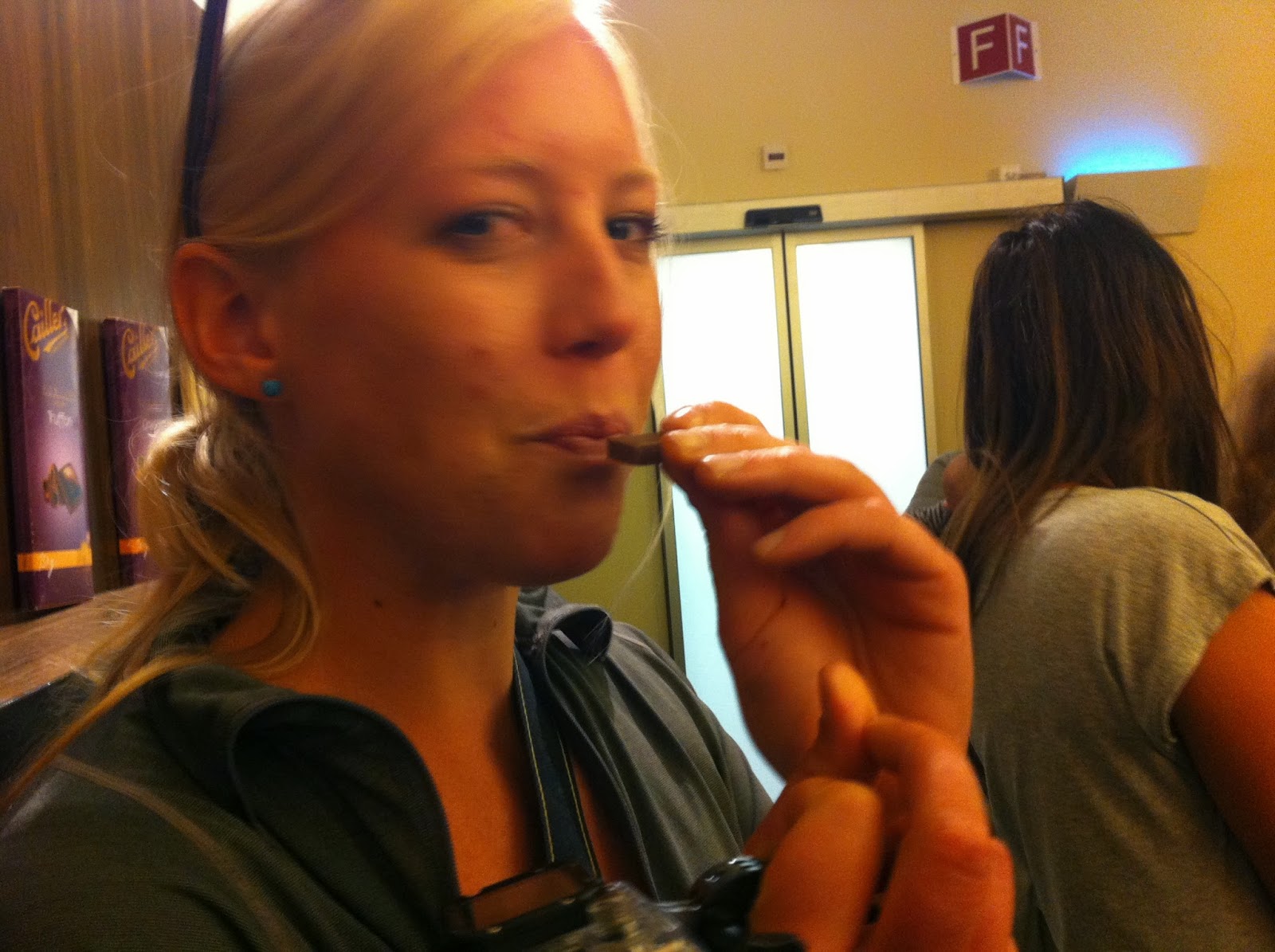
“That makes two of us,” I replied.
Tour groups came and went. Whitney and I positioned ourselves
strategically and inconspicuously at the back of the room, from which we could
reach forward through the crowd and glean from the bountiful harvest largely
unnoticed. I kept my eye on the woman stocking the trays to see whether she
suspected our designs, but after 20 or 30 minutes she left and we were free to
feast unrestrained.
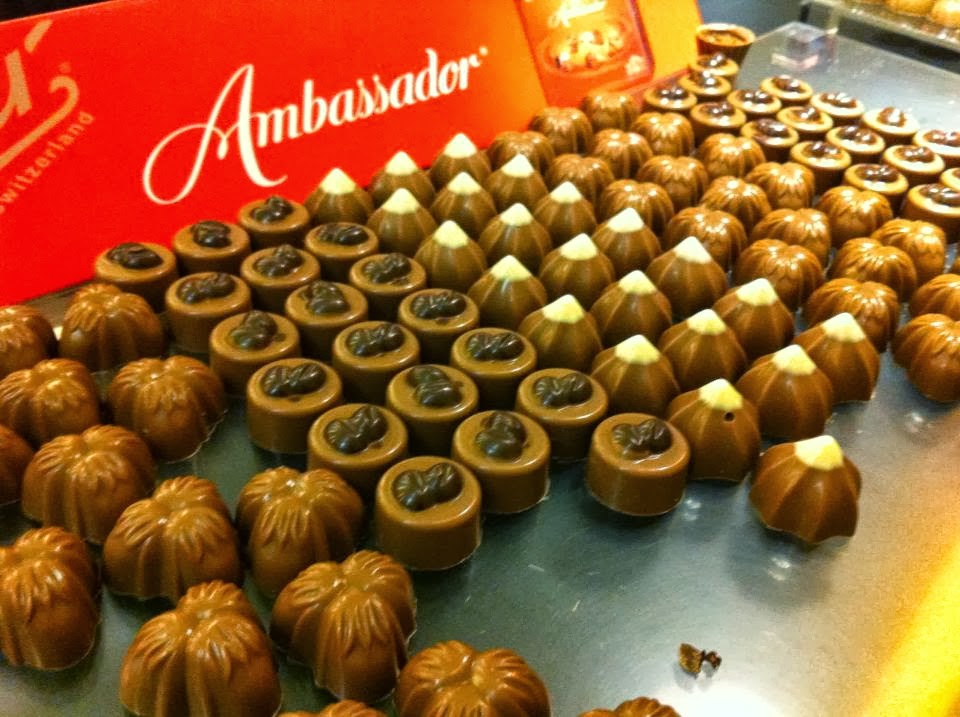
There was a more persistent theme of hazelnut than I would have
preferred in the perfect ideal of ideals, but
the chocolate was rich and creamy and ranged from simple lights and darks to fruit- and coffee-filled works of art from the “Noir Ambassador” series. I enjoyed experimenting with creative combinations of different chocolates and often circled back to the simpler chocolates higher up the table for a palate cleanser
 now and then. I tried each
kind at least once, and quite a few three or four times. When I put the last
chocolate in my mouth, I knew it was the last one. Not another would fit in my
tummy. I wasn’t sick of chocolate, just incapable of one piece more beyond
that. We drew a deep, satisfied breath and walked out past a white chocolate
model of the factory to the gift shop. I retrieved my paraglider from the
cinema and bought a postcard as a souvenir.
now and then. I tried each
kind at least once, and quite a few three or four times. When I put the last
chocolate in my mouth, I knew it was the last one. Not another would fit in my
tummy. I wasn’t sick of chocolate, just incapable of one piece more beyond
that. We drew a deep, satisfied breath and walked out past a white chocolate
model of the factory to the gift shop. I retrieved my paraglider from the
cinema and bought a postcard as a souvenir.
the chocolate was rich and creamy and ranged from simple lights and darks to fruit- and coffee-filled works of art from the “Noir Ambassador” series. I enjoyed experimenting with creative combinations of different chocolates and often circled back to the simpler chocolates higher up the table for a palate cleanser

 now and then. I tried each
kind at least once, and quite a few three or four times. When I put the last
chocolate in my mouth, I knew it was the last one. Not another would fit in my
tummy. I wasn’t sick of chocolate, just incapable of one piece more beyond
that. We drew a deep, satisfied breath and walked out past a white chocolate
model of the factory to the gift shop. I retrieved my paraglider from the
cinema and bought a postcard as a souvenir.
now and then. I tried each
kind at least once, and quite a few three or four times. When I put the last
chocolate in my mouth, I knew it was the last one. Not another would fit in my
tummy. I wasn’t sick of chocolate, just incapable of one piece more beyond
that. We drew a deep, satisfied breath and walked out past a white chocolate
model of the factory to the gift shop. I retrieved my paraglider from the
cinema and bought a postcard as a souvenir.  Though we had reached the heavenly gates and tasted the food of
paradise, our pilgrimage was not over. As the day waned, bright sunbeams
pierced the clouds and fell on a majestic castle on a hill some miles down the road.
We left the chocolate factory and plodded slowly toward Gruyères, the land of cheese.
Though we had reached the heavenly gates and tasted the food of
paradise, our pilgrimage was not over. As the day waned, bright sunbeams
pierced the clouds and fell on a majestic castle on a hill some miles down the road.
We left the chocolate factory and plodded slowly toward Gruyères, the land of cheese.


